Teilziel 4.3: SIMPLE PAST
(= 1.Vergangenheit)
(= 1.Vergangenheit)
Simple past
Ich weiß, was der Fachbegriff simple past
bedeutet.
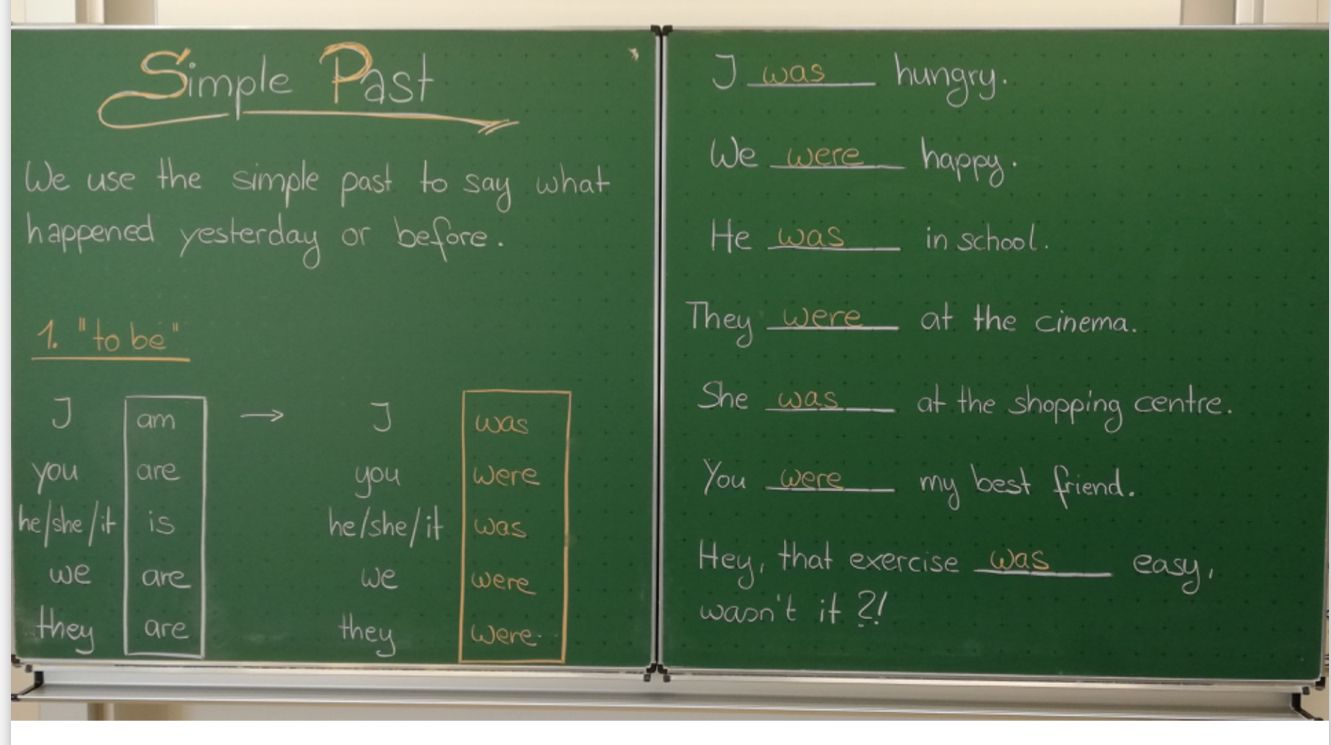
to be
im simple past
Ich kann die Formen von sein
im simple past bilden.
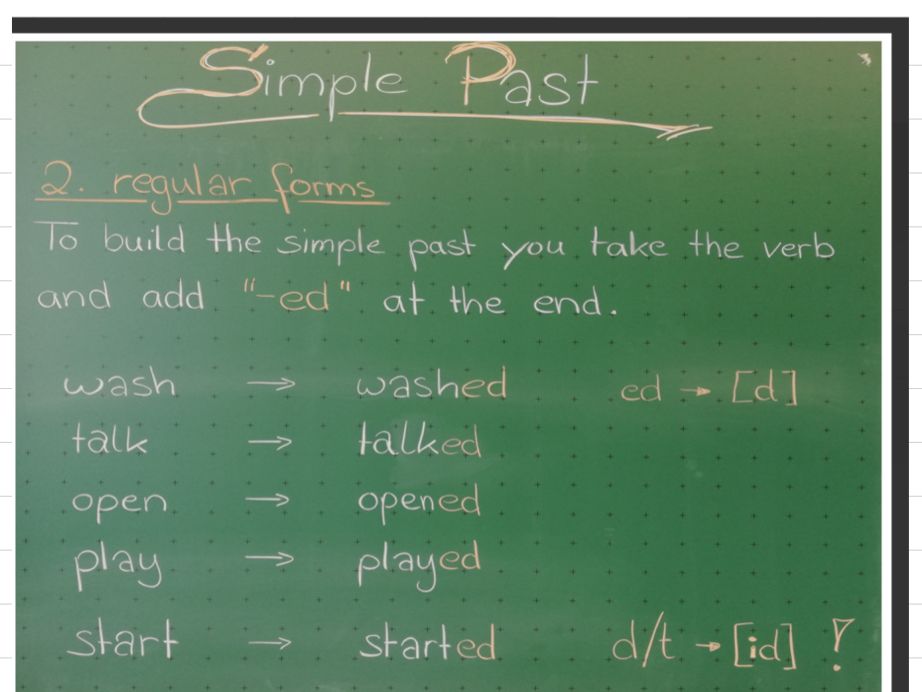
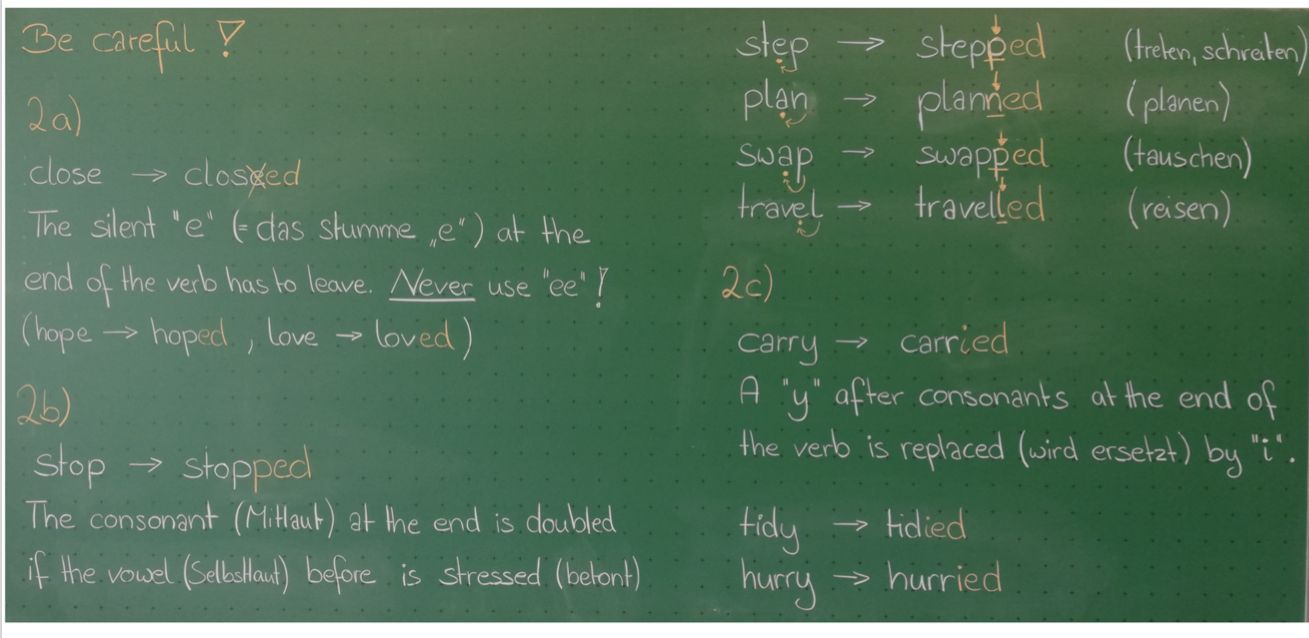
regular forms
Ich kann Verben in der regelmäßigen Form im simple past bilden.
irregular forms
Ich kann Verben in der unregelmäßigen Form im simple past bilden.
Verneinung im simple past
Ich kann Verneinung im simple past im Englischen bilden.
Selbstcheck: Simple past
Aufgabe 1
Aufgabe 2
Aufgabe 3
Aufgabe 4
Aufgabe 5
Aufgabe 6
Aufgabe 7
Aufgabe 8
Aufgabe 9
Aufgabe 10
Aufgabe 11
Aufgabe 12
Aufgabe 13
Aufgabe 14
Aufgabe 15
Aufgabe 15
Aufgabe 17
Aufgabe 18
Check-out
New tense: SIMPLE PAST

Du verwendest das SIMPLE PAST, um über die Vergangenheit zu sprechen. Das SIMPLE PAST kommt oft in Berichten, Geschichten und Erzählungen vor.
1. Simple past form of to be
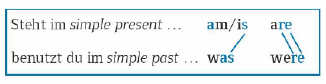
(war / warst / waren)
to be (war / warst / waren)
Bejahte Aussagesätze mit was/were
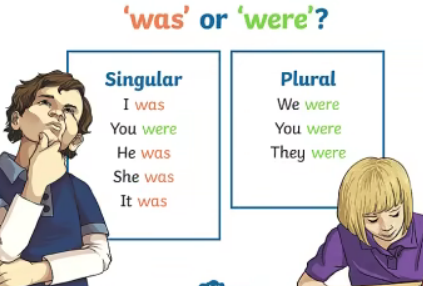
a) Ben in London last year.
b) Yesterday Kinga at the zoo.
c) She at the monkey cage for a long time.
d) One of the monkeys really funny.
e) Li and Kinga at a birthday party on Saturday.
f) We at the party for a long time.
g) In 2011 the kids still in kindergarden.
h) They really cute as little kids.
Verneinte Aussagesätze mit was/were
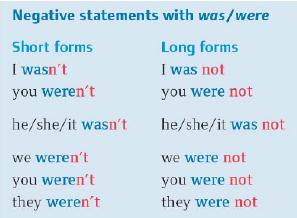
a) Jalen (+) in town yesterday. He (-) at home.
b) Jalen's cousin and his mum and dad (+) with him.
c) They (+) at the skating rink and Smeaton's Tower.
d) The tower and the skating rink (-) open.
e) Ben (-) at home. He (+) at the shopping centre.
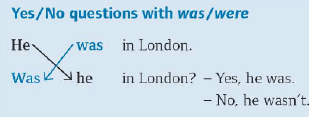
Entscheidungsfragen mit was/were
a) you at the party yesterday? - No, .
b) Sue with you? - Yes, .
c) the kids at the zoo? - Yes, .
d) he at the game on the weekend? - No, .
e) they sick last week? - No, .


2. Simple past: Regular forms
Die regular form der Verben im simple past bildest du aus dem Infinitiv des Verbs und der Endung -ed.
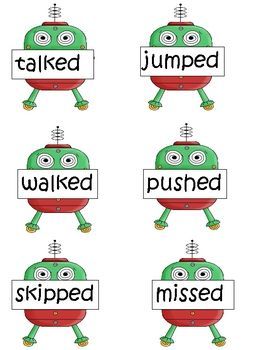
a) act: b) like:
c) help: d) want:
e) watch: f) clap:
g) smile: h) hurry:
i) travel: j) play:

Simple past: Irregular forms
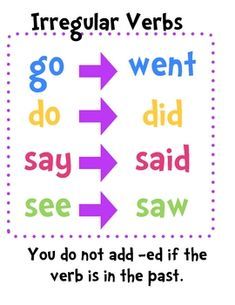
Einige Verben haben unregelmäßige Formen im simple past. Auf der Seite 249 findest du eine Liste aller unregelmäßigen Verben aus Go Ahead 5. Diese musst du auswendig lernen!
a) have: b) do:
c) go: d) tell:
e) swim: f) see:
g) sit: h) feel:
i) write: j) say:




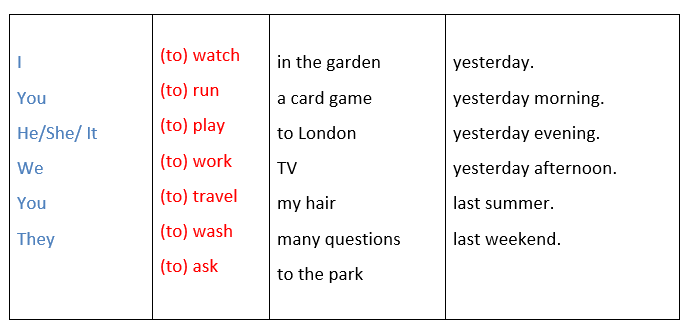
Example: a) I worked in the garden last weekend.
b) You
c) He
d) She
e) We
f) You
g) They
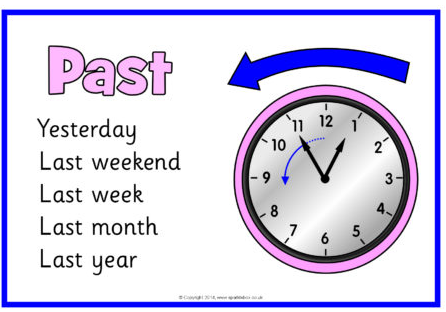

3. Simple past: Verneinung simple past
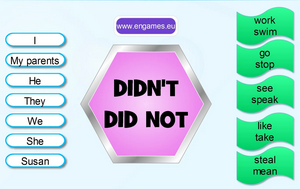
Example: All the pupils talked , but Tom didn't talk. (to) talk
1. All the children , but Betty . (to) laugh
2. Alex by bike, but John by bike. (to) come
3. Mr Brown the film, but his wife it. (to) see
4. Sally TV, but her parents TV. (to) watch


verbs in brackets. Watch out: Some of the verbs are irregular!
Tim (get up) early. He (have)
breakfast and (do) his homework. Then he (go) to the park with his dog, Sam. In the park he (see) his neighbours Dave and Sally who (ride) on their bikes. They (come) back from the supermarket where they (buy) their breakfast. As the two (stop) to say hello to Tim, Sally (fall off) her bike because Sam (go) right in front of her bike. Sally (be) shocked because she (land) on her back on the ground. She (say) to Tom: Why (you / not watch) your dog? Tom (be) sorry. He (lift) her bike up from the ground and (help) her to get back on her feet. Tom (say) goodbye and (explain) to his neighbours that he (be) in a hurry. He (return) home and (get) ready for school. Sam likes walks and when Tim (leave) home for school, Sam (run) after him. Tim (not see) him until he (be) at the bus stop. Then Tim (see) Sam and (take) him back home. Tim (miss) his bus so he (be) very late for school yesterday.
Your Check: Unit 4

Test freischalten
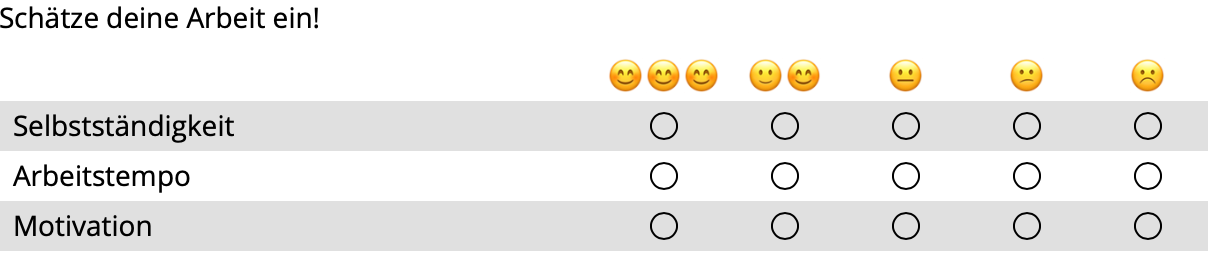
Zum Skills Test gelangst Du erst, nachdem Du die Selbsteinschätzung ausgefüllt hast.
Alles erledigt? Hast du auch mit den Lösungen verglichen? Gehe nun mit deinem Lernpaket zu einer Englisch-Lehrerin oder einem Englisch-Lehrer und lasse dir bestätigen, dass Du weiterarbeiten darfst.